
Warehouse storage is not simply about fitting more products into a building. The right storage system should improve space utilization, accessibility, material flow, inventory organization and the way employees and equipment move through the facility.
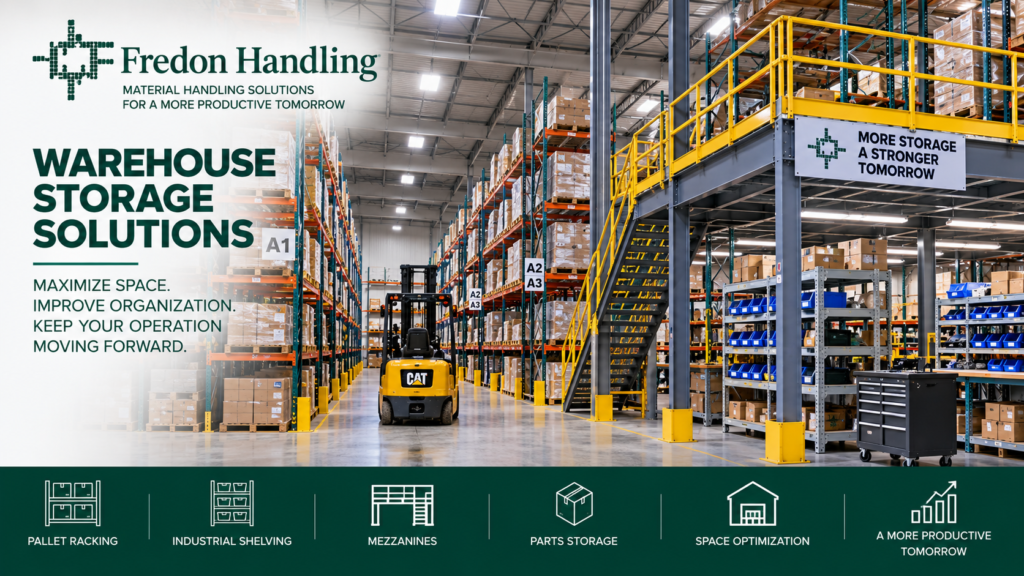
Fredon Handling provides warehouse storage solutions for manufacturers, warehouses, distribution centers, parts departments and other industrial operations.
Whether you need pallet racking, industrial shelving, mezzanines, parts storage or a more efficient warehouse layout, Fredon Handling can help evaluate your inventory, space and workflow and identify storage solutions suited to your operation.
What Is a Warehouse Storage Solution?
A warehouse storage solution is the combination of equipment, layout and operating practices used to organize and store materials within a facility.
Depending on the application, a complete storage system may include:
- Pallet racking
- Industrial shelving
- Cantilever racking
- Pallet flow systems
- Drive-in racking
- Mezzanines
- Parts storage
- Modular cabinets
- Work-in-process storage
- Staging areas
The best storage system is not necessarily the one that provides the greatest theoretical density.
It is the one that provides the right balance of storage capacity, accessibility and material flow.
Common Warehouse Storage Challenges
Facilities often begin looking for new storage solutions when they experience problems such as:
- Running out of pallet positions
- Inventory stored in aisles
- Poor use of vertical space
- Difficult product access
- Excessive forklift travel
- Crowded parts rooms
- Slow picking
- Poor inventory organization
- Inadequate staging areas
- Different products stored in unsuitable systems
- Frequent movement of inventory just to reach other inventory
These problems can reduce warehouse efficiency even when the building technically has enough square footage.
Pallet Racking Solutions
Pallet racking is one of the most common warehouse storage systems for palletized inventory.
Different rack types provide different balances between accessibility and density.
Selective Pallet Racking
Selective pallet rack provides direct access to individual pallet positions.
It can be especially useful when a warehouse stores many different SKUs and needs frequent access to individual pallets.
Selective racking provides strong accessibility but generally uses more aisle space than higher-density systems.
Drive-In and Drive-Through Racking
Drive-in and drive-through racking allow forklifts to enter storage lanes.
These systems can increase storage density and may be appropriate where larger quantities of similar products are stored.
They are commonly considered when reducing aisle space is more important than direct access to every pallet.
Pallet Flow Racking
Pallet flow systems use gravity lanes to move pallets through the rack structure.
They can support first-in, first-out inventory movement and may be useful for high-volume products with predictable inventory rotation.
Cantilever Racking
Cantilever racking is designed for long, bulky or irregular products that do not fit conventional pallet rack well.
Common applications include:
- Pipe
- Tubing
- Lumber
- Bar stock
- Sheet materials
- Furniture
- Long components
Industrial Shelving
Not every product should be stored on pallet rack.
Industrial shelving is often better suited for:
- Small parts
- Cartons
- Tools
- MRO supplies
- Maintenance inventory
- Components
- Hand-picked products
Shelving can help create more organized storage close to workstations, parts rooms and picking areas.
A warehouse may use pallet racking for reserve inventory while shelving supports smaller quantities needed for daily operations.
Parts Storage Solutions
Parts storage can become inefficient quickly when thousands of small items are placed into generic shelving without a clear organization strategy.
A better parts storage system may combine:
- Industrial shelving
- Bins
- Modular cabinets
- Drawers
- Labels
- Point-of-use storage
- Mezzanine storage
The goal is to place frequently used items where employees can access them efficiently while keeping reserve inventory organized.
Warehouse Mezzanines
A warehouse mezzanine can create additional usable storage space within the existing building.
If the facility has sufficient clear height, a mezzanine may provide room for:
- Small parts storage
- Carton storage
- Picking operations
- Maintenance inventory
- Packaging supplies
- Production support
Mezzanines can be particularly valuable when floor space is constrained but significant vertical space remains unused.
Using Vertical Warehouse Space
Many warehouses focus on floor area while leaving valuable cubic space underused.
Vertical storage opportunities may include:
- Taller pallet racking
- Mezzanines
- Multi-level shelving
- High-density storage
- Overhead storage areas
Before changing storage height, facilities should evaluate building conditions, equipment capabilities, sprinkler requirements and applicable structural and safety requirements.
Warehouse Storage Density
Storage density describes how much inventory can be stored within a given area.
Increasing density can be valuable, but greater density is not always better.
A dense storage system may reduce accessibility or require more product movement to retrieve individual pallets.
Warehouse storage planning should balance:
- Storage capacity
- Product accessibility
- Forklift movement
- Picking frequency
- Inventory rotation
- Labor requirements
Warehouse Aisle Width
Aisle width has a major effect on both storage capacity and forklift movement.
Narrower aisles can increase the number of rack positions within a warehouse, but they may also require specific lift equipment and operating practices.
Aisle planning should account for:
- Forklift type
- Turning radius
- Load dimensions
- Rack depth
- Employee traffic
- Safety clearances
- Picking methods
The warehouse layout should be designed around the equipment actually being used.
Storage Solutions for Fast-Moving Inventory
High-velocity products should generally be stored where they can be accessed with minimal travel.
Possible strategies include:
- Placing fast-moving SKUs near shipping or production
- Using pallet flow rack
- Creating dedicated picking zones
- Using shelving for smaller high-frequency items
- Maintaining reserve inventory behind or above pick locations
Storage location can significantly affect warehouse productivity.
Storage Solutions for Slow-Moving Inventory
Slow-moving products may not need premium locations near primary picking or shipping areas.
They may be stored:
- Higher in pallet rack
- Farther from shipping
- In less accessible storage zones
- In reserve storage areas
Separating high-velocity and low-velocity inventory can help make better use of valuable warehouse space.
Warehouse Storage for Manufacturing
Manufacturing facilities often need storage for more than finished goods.
They may need to organize:
- Raw materials
- Components
- Work-in-process
- Finished products
- MRO supplies
- Tools
- Packaging materials
Each material type may require a different storage approach.
For example, pallet rack may hold raw materials, shelving may support assembly parts and mezzanine storage may hold maintenance inventory.
Work-in-Process Storage
Work-in-process storage can easily become disorganized when materials wait between production steps.
An effective WIP storage system should help:
- Keep material identifiable
- Prevent aisle congestion
- Reduce unnecessary movement
- Support production flow
- Limit excessive inventory buildup
The right equipment depends on product size, process sequence and handling method.
Warehouse Staging Areas
Receiving and shipping areas need enough staging space to prevent materials from blocking docks, aisles or storage locations.
Staging should be planned around:
- Daily inbound volume
- Outbound volume
- Trailer schedules
- Inspection requirements
- Picking processes
- Storage locations
Poorly planned staging areas can create bottlenecks even when warehouse storage itself is well designed.
Warehouse Storage and Material Flow
Storage systems should support the way products move through the facility.
A common warehouse flow might look like:
Receiving → Inspection → Storage → Picking → Staging → Shipping
Every unnecessary move adds time and labor.
The storage layout should minimize unnecessary travel while keeping products accessible.
Warehouse Storage and Forklift Traffic
Forklift movement is closely connected to storage design.
Consider:
- Main travel aisles
- Cross aisles
- Rack aisles
- Receiving
- Shipping
- Charging areas
- Pedestrian routes
Storage systems that create frequent congestion can reduce productivity even if they increase theoretical capacity.
High-Density Storage vs. Selective Storage
High-density systems can store more pallets within a smaller footprint.
Selective storage provides better access to individual SKUs.
The correct choice depends on:
- SKU count
- Pallets per SKU
- Inventory rotation
- Product velocity
- Forklift access
- Picking requirements
Many warehouses use a combination of both.
New Warehouse Storage vs. Reconfiguring Existing Storage
A warehouse storage problem does not always require new equipment.
In some cases, capacity may improve by:
- Reassigning storage locations
- Changing aisle layouts
- Adjusting rack elevations
- Relocating slow-moving inventory
- Creating better staging areas
- Using vertical space
- Adding shelving for smaller products
An assessment of the existing system should generally come before purchasing additional storage equipment.
Warehouse Storage and Future Growth
Storage systems should account for more than today’s inventory.
Ask:
- Is SKU count increasing?
- Are pallet quantities growing?
- Are products becoming larger?
- Will different forklifts be introduced?
- Is production expanding?
- Is e-commerce or order picking increasing?
- Will additional employees use the space?
Planning for reasonable future growth can reduce the need for repeated warehouse reconfiguration.
Information to Gather Before Planning a Storage System
Before contacting Fredon Handling, gather as much information as possible about the facility and inventory.
Useful information includes:
- Building dimensions
- Clear height
- Column locations
- Number of pallets
- Pallet dimensions
- Maximum pallet weight
- Number of SKUs
- Inventory turnover
- Forklift type
- Current aisle widths
- Picking methods
- Shipping volume
- Receiving volume
- Growth expectations
- Current storage problems
Facility drawings, photos and inventory data can also be helpful.
Frequently Asked Questions About Warehouse Storage
What is the best warehouse storage system?
There is no single best system. The appropriate solution depends on inventory type, pallet quantities, SKU count, picking frequency, forklift equipment, available space and required accessibility.
What is the difference between pallet racking and industrial shelving?
Pallet racking is primarily designed for palletized loads handled with forklifts or other lift equipment. Industrial shelving is generally used for smaller products, cartons, tools and manually accessed inventory.
How can I increase warehouse storage capacity?
Possible strategies include improving rack layout, using vertical space, adding mezzanines, increasing storage density, reorganizing SKUs and selecting storage systems better suited to the inventory.
Is high-density pallet racking always better?
No. Higher density can reduce direct product accessibility. The correct balance depends on inventory rotation, product velocity and SKU count.
Can a mezzanine increase warehouse storage space?
Yes. Where sufficient vertical space and appropriate building conditions exist, a mezzanine can create another usable level for storage or other operations.
How should warehouse storage be organized?
Warehouse storage should account for product velocity, inventory type, accessibility, forklift movement, picking methods and the overall material flow through the facility.
Create a Warehouse Storage System Around Your Operation
The right warehouse storage system begins with understanding your inventory, facility and material flow.
Fredon Handling can help evaluate your current storage, identify capacity constraints and determine whether pallet racking, industrial shelving, mezzanines or other warehouse storage solutions may be appropriate.
Tell us what you need to store, how much space you have and what problems you are trying to solve.