
Moving material is only part of material handling. In many manufacturing and warehouse operations, the bigger challenge is getting the load into the right height, orientation and position for employees or equipment to work with it efficiently.
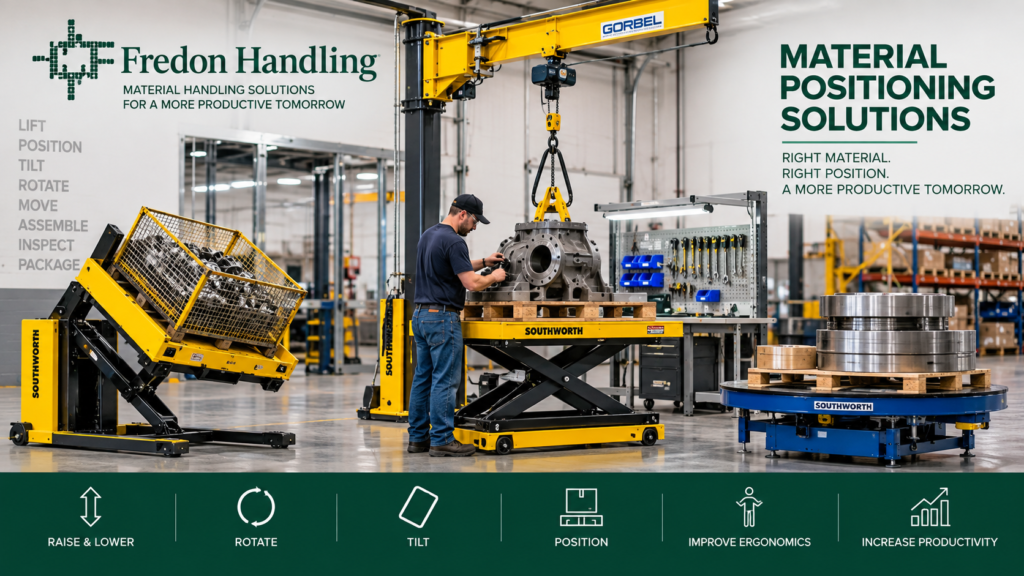
Fredon Handling provides industrial material positioning solutions designed around the way materials are actually handled within your facility.
Whether you need to raise a pallet to working height, rotate a load, position a heavy component for assembly or reduce repetitive manual handling, Fredon can help evaluate the application and identify equipment suited to the task.
What Is Material Positioning?
Material positioning is the process of placing a load where it needs to be for handling, assembly, production, inspection, packaging or transfer.
Instead of requiring employees to continually adapt themselves to the location of the material, positioning equipment helps bring the material closer to the location and orientation required by the process.
Material positioning may involve:
- Raising or lowering
- Tilting
- Rotating
- Turning
- Lifting
- Reorienting
- Holding
- Moving a load into a working position
The right solution depends on the material, process, employees and surrounding equipment.
Common Material Positioning Challenges
Facilities often benefit from material positioning equipment when employees are repeatedly:
- Bending toward floor-level pallets
- Reaching into deep containers
- Manually rotating heavy components
- Repositioning parts during assembly
- Moving awkward loads
- Working at uncomfortable heights
- Waiting for forklifts to reposition material
- Handling the same product several times
- Moving loads between different equipment heights
These problems can affect productivity, ergonomics and material flow.
The solution is not always simply a larger piece of equipment. The goal is to determine where the material needs to be and how it should get there.
Hydraulic Lift Tables
Hydraulic lift tables raise and lower materials to different working heights.
They can be useful in:
- Assembly
- Manufacturing
- Packaging
- Palletizing
- Depalletizing
- Machine loading
- Inspection
- Material transfer
A lift table can help keep work closer to an appropriate operating height as the process changes.
Pallet Positioners
Working directly from floor-level pallets can require employees to bend farther as products are removed.
Pallet positioning equipment can help maintain material at a more practical working position throughout loading and unloading.
Applications may include:
- Palletizing
- Depalletizing
- Order picking
- Assembly
- Packaging
- Production feeding
The objective is to reduce unnecessary changes in working height as the pallet fills or empties.
Tilt Tables
Some materials are difficult to access when they remain flat.
Industrial tilt tables can angle containers, bins or other loads toward the operator, making their contents easier to reach.
Tilt tables may be useful for:
- Parts picking
- Assembly
- Component retrieval
- Container unloading
- Production workstations
The appropriate tilt angle and capacity depend on the load and task.
Industrial Turntables
Turntables allow materials to rotate while remaining supported in one location.
Instead of walking around a large product or manually turning the load, an operator may be able to rotate the material into the desired position.
Applications may include:
- Assembly
- Packaging
- Inspection
- Welding
- Palletizing
- Production
Turntables can also be combined with other positioning equipment depending on the application.
Cranes & Hoists for Material Positioning
Some loads need to move in more than one direction.
Cranes and hoists can help lift and position heavy or awkward components when hydraulic tables or floor-based positioning equipment alone cannot provide the required movement.
Possible solutions include:
- Workstation bridge cranes
- Jib cranes
- Gantry cranes
- Hoists
- Below-the-hook lifting devices
These systems can be especially useful for machine loading, assembly and heavy component handling.
Industrial Workstations & Material Positioning
Material positioning should also be considered when designing industrial workstations.
An effective workstation may combine:
- Work surfaces
- Parts storage
- Lift tables
- Pallet positioners
- Overhead lifting
- Tool storage
- Component presentation
Instead of treating each piece of equipment separately, the entire work area can be designed around how material enters, is worked on and leaves the station.
Material Positioning for Manufacturing
Manufacturing facilities may use positioning equipment throughout the production process.
Common applications include:
- Machine tending
- Assembly
- Welding
- Fabrication
- Packaging
- Inspection
- Parts presentation
- Component installation
For example, a heavy component may arrive by forklift, be transferred to a lift table and then positioned with an overhead crane during assembly.
Each piece of equipment performs a different part of the movement.
Material Positioning for Warehouses
Warehouse applications may involve:
- Pallet loading
- Pallet unloading
- Picking
- Packing
- Repacking
- Returns processing
- Container handling
Positioning products closer to the employee can help reduce unnecessary movement during repetitive warehouse tasks.
Material Positioning and Ergonomics
A major reason facilities evaluate positioning equipment is to improve how employees interact with materials.
Repetitive tasks may involve:
- Bending
- Reaching
- Twisting
- Lifting
- Pulling
- Pushing
- Repositioning
Material positioning equipment can help reduce some of these movements by bringing the load into a more useful position.
However, equipment should be selected around the complete task rather than assuming any single device automatically solves an ergonomic problem.
Important factors include:
- Working height
- Reach distance
- Load weight
- Load geometry
- Task frequency
- Operator position
- Material flow
How to Choose a Material Positioning Solution
Start with the work that needs to be performed.
What Is Being Handled?
Identify:
- Weight
- Dimensions
- Shape
- Stability
- Container type
Where Is the Material Now?
Determine the starting height and orientation.
Where Does It Need to Be?
Identify the ideal working or transfer position.
What Movement Is Required?
Does the load need to:
- Raise?
- Lower?
- Tilt?
- Rotate?
- Travel horizontally?
- Be suspended?
- Perform several movements?
How Often Does the Task Occur?
Repetitive production applications may require a different solution from occasional maintenance tasks.
How Does the Employee Interact With the Load?
Look at:
- Reach
- Working height
- Movement
- Tool use
- Access requirements
What Other Equipment Is Involved?
Material positioning may need to integrate with:
- Forklifts
- Pallet jacks
- Conveyors
- Workstations
- Cranes
- Racking
- Packaging equipment
- Production machinery
Solve the Positioning Problem, Not Just the Lifting Problem
A common mistake is focusing only on the weight of the material.
Two loads weighing exactly the same may require completely different equipment.
One may simply need to move vertically.
Another may need to be:
Lifted, rotated, tilted and precisely positioned beside a machine.
The right question is therefore not:
“How do we lift this?”
It is:
“Where does this material need to be, and what movements are required to get it there?”
That approach leads to better equipment decisions.
Information to Gather Before Contacting Fredon Handling
Helpful application information includes:
- Maximum load weight
- Load dimensions
- Starting position
- Desired working position
- Required movement
- Required lift height
- Handling frequency
- Operator interaction
- Available floor space
- Existing equipment
- Photos of the work area
- Current material-handling problems
The more detail available, the easier it is to evaluate potential solutions.
Frequently Asked Questions About Material Positioning
What is material positioning equipment?
Material positioning equipment raises, lowers, rotates, tilts or otherwise places materials into a useful working or transfer position.
What equipment is used for material positioning?
Depending on the application, equipment may include hydraulic lift tables, pallet positioners, tilt tables, turntables, cranes, hoists and specialized handling devices.
What is the difference between lifting and positioning?
Lifting primarily changes the vertical position of a load. Positioning may also involve rotation, tilting, orientation or horizontal movement so the material reaches the position required by the task.
Can material positioning equipment improve ergonomics?
Properly selected equipment can help reduce unnecessary bending, reaching, lifting and repositioning. The complete task should be evaluated when addressing ergonomic concerns.
How do I know what type of positioning equipment I need?
Start with the load weight, dimensions, required movement, desired working position, handling frequency and how employees interact with the material.
Find the Right Material Positioning Solution
The most effective material positioning system begins with understanding what the load needs to do.
Fredon Handling can help evaluate the material, workflow, employee interaction and surrounding equipment to identify an appropriate solution.
Whether you need to lift, lower, rotate, tilt or position a load for production, assembly or material handling, we can help you evaluate the options.