
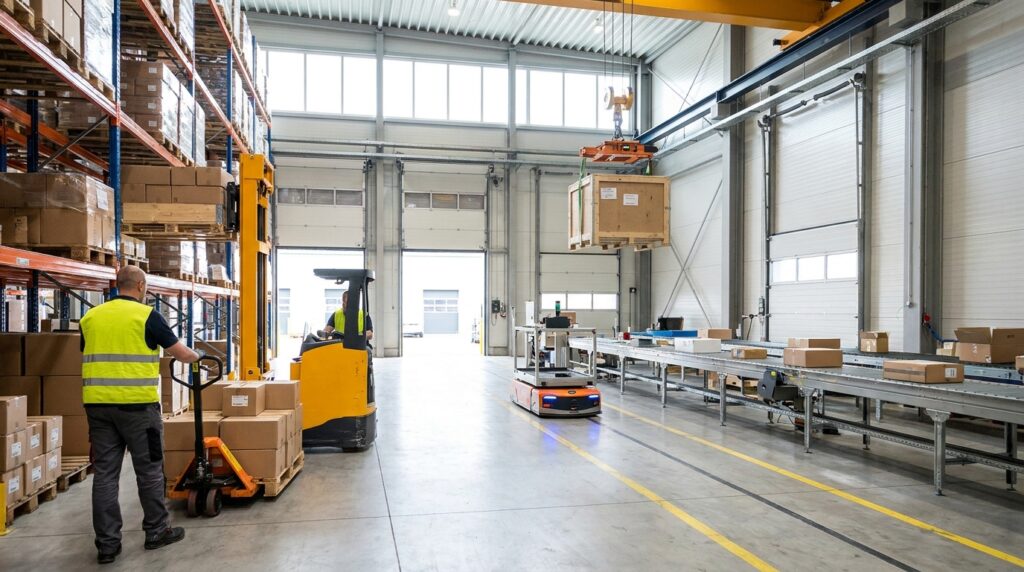
Material handling equipment forms the backbone of every efficient warehouse, manufacturing facility, and distribution center. Whether you are moving raw materials into production, transferring work-in-progress between stations, or shipping finished goods to customers, the right tools determine how fast, safely, and cost-effectively those tasks get done. Understanding the major categories of material handling equipment—and how each type fits into a broader operational strategy—helps facility managers, warehouse operators, and operations professionals make informed purchasing decisions that pay dividends for years.
This guide breaks down the essential types of material handling equipment, explains where each category excels, highlights safety and selection considerations, and shows how the right combination of solutions can transform throughput and workplace safety.
Understanding the Core Categories of Material Handling Equipment
The Material Handling Industry of America (MHI) organizes equipment into four broad categories: storage and handling, engineered systems, industrial trucks, and bulk material handling. Within each category sit dozens of product families, from simple hand trucks to fully automated storage and retrieval systems. Knowing which category addresses your pain point is the first step toward a sound investment.
Storage and Handling Equipment
Storage and handling equipment is designed to hold, organize, and protect materials when they are not actively being transported. This category includes:
- Pallet racking systems – selective, drive-in, push-back, pallet flow, and cantilever configurations that maximize vertical cube utilization.
- Shelving and bin systems – lighter-duty units ideal for small-parts storage, picking operations, and maintenance cribs.
- Mezzanines and work platforms – structural or rack-supported platforms that create additional floor space without expanding your building footprint.
- Stacking frames and containers – reusable steel or plastic units that protect parts during storage and transport.
Pallet racking alone can double or triple usable storage density compared to floor stacking. Fredon Handling offers a full range of pallet racking solutions—from selective rack for high-SKU environments to drive-in rack for deep-lane, high-density storage—engineered to match your load profiles and throughput requirements.
Industrial Trucks and Powered Vehicles
Industrial trucks encompass every powered or manual vehicle used to move materials horizontally or vertically across short distances. Common examples include:
- Counterbalance forklifts (electric, LP gas, diesel)
- Reach trucks and order pickers
- Pallet jacks (manual and powered)
- Platform trucks and carts
- Automated guided vehicles (AGVs) and autonomous mobile robots (AMRs)
Selecting the right truck depends on aisle width, lift height, load weight, duty cycle, and indoor versus outdoor use. A narrow-aisle reach truck, for instance, lets you tighten rack aisles to 8–10 feet and recover significant square footage, while a heavy-duty counterbalance forklift is better suited for loading dock work and outdoor yard operations.
Engineered Systems
Engineered systems are typically custom-designed installations that automate or semi-automate the movement and sorting of materials. They include:
- Conveyors – belt, roller, chain, and overhead varieties that move goods continuously between processes.
- Sortation systems – diverters, tilt-tray sorters, and crossbelt sorters that route items to the correct destination.
- Automated storage and retrieval systems (AS/RS) – crane-based or shuttle-based solutions for high-density, high-throughput storage.
- Pick-to-light and voice-directed systems – technology overlays that increase picking accuracy and speed.
Engineered systems demand higher upfront investment but deliver measurable returns in labor savings, accuracy, and throughput—especially in operations handling more than a few hundred orders per day.
Bulk Material Handling Equipment
Facilities that process loose materials—grain, aggregates, chemicals, powders, or scrap—rely on bulk handling equipment such as hoppers, silos, conveyor belts, bucket elevators, and pneumatic transfer systems. While niche compared to the other categories, bulk handling solutions are critical in mining, agriculture, food processing, and chemical manufacturing.
For those interested in exploring the various types of material handling equipment, a related article that provides comprehensive insights is available at Fredon Handling. This resource delves into the different categories of equipment used in material handling, including forklifts, conveyor systems, and pallet jacks, offering valuable information for businesses looking to optimize their operations.
Lifting and Positioning Equipment That Improves Ergonomics and Productivity
Beyond the four MHI categories, a significant subset of material handling equipment focuses specifically on lifting, lowering, and positioning loads. This equipment reduces manual strain, prevents injuries, and speeds cycle times at individual workstations and throughout the facility.
Hydraulic Lift Tables and Scissor Lifts
Hydraulic lift tables raise or lower loads to ergonomic working height, eliminating repetitive bending and reaching. They are used for:
- Pallet loading and unloading at packing stations
- Die and mold changes in stamping and injection-molding operations
- Transferring loads between conveyors at different elevations
- Positioning heavy components for assembly
Fredon Handling supplies a wide selection of hydraulic lifts—from compact 1,000-pound-capacity tables to heavy-duty units rated above 10,000 pounds—along with tilt tables, rotating tops, and custom platform sizes that integrate seamlessly into production workflows.
Cranes and Hoists
Overhead cranes and hoists handle loads too heavy or awkward for forklifts. Key types include:
- Bridge cranes – single- or double-girder designs spanning an entire bay for maximum hook coverage.
- Jib cranes – wall-mounted or freestanding booms that serve a specific workstation or machine.
- Gantry cranes – portable or semi-portable structures useful in outdoor yards and facilities without overhead runway steel.
- Chain and wire-rope hoists – electric or manual units that provide the actual lifting force, rated from a fraction of a ton to hundreds of tons.
Cranes and hoists are indispensable in heavy manufacturing, steel service centers, tool-and-die shops, and maintenance operations. Fredon’s crane and hoist solutions include engineering support for runway design, load analysis, and installation, ensuring your overhead lifting system meets OSHA, ASME, and CMAA standards.
Ergonomic Workstations and Positioning Devices
Ergonomic workstations combine adjustable work surfaces, integrated lifting devices, tool balancers, and parts-presentation fixtures into a single operator environment. Benefits include:
- Reduced musculoskeletal disorder (MSD) risk
- Faster assembly cycle times
- Lower scrap and rework rates due to better part orientation
- Improved employee satisfaction and retention
Fredon Handling designs and supplies industrial workstations that can be configured with hydraulic or electric height adjustment, integrated lighting, and connectivity for powered tools—creating a purpose-built environment that keeps operators safe and productive.
Loading Dock Equipment and Its Role in the Supply Chain
The loading dock is the critical handoff point between your facility and the transportation network. Inefficiencies or safety gaps at the dock ripple upstream and downstream, causing trailer detention charges, shipping delays, and injury claims. Essential loading dock equipment includes:
- Dock levelers – mechanical, hydraulic, or air-powered platforms that bridge the gap and height difference between the dock and the trailer floor.
- Dock shelters and seals – foam-pad or curtain systems that maintain climate control and keep weather, debris, and pests out of the facility.
- Vehicle restraints – mechanical hooks or wheel chocks that prevent trailer creep during loading and unloading.
- Dock bumpers – rubber or laminated pads that protect the building from trailer impact.
- Dock lights and communication systems – LED lights and traffic signals that improve visibility and coordinate truck-to-dock activity.
Fredon Handling provides comprehensive loading dock equipment packages, from single-leveler replacements to full dock-renovation projects, ensuring your receiving and shipping operations are safe, energy-efficient, and fast.
Safety Considerations Across All Types of Material Handling Equipment
No discussion of material handling equipment is complete without addressing safety. According to the Bureau of Labor Statistics, forklift-related incidents alone account for roughly 85 fatalities and 34,900 serious injuries each year in the United States. Across all equipment types, the primary safety concerns include:
- Overloading – exceeding rated capacity causes structural failure in racking, crane collapse, and forklift tip-overs.
- Inadequate training – OSHA requires documented operator training for powered industrial trucks (29 CFR 1910.178) and crane operations (29 CFR 1910.179).
- Poor maintenance – worn chains, leaking hydraulic cylinders, and damaged rack components introduce hidden risks.
- Struck-by and caught-between hazards – pedestrians near forklifts, operators near conveyors, and workers under overhead loads face serious exposure.
- Falls from height – mezzanine edges, raised platforms, and order-picker trucks all require guardrails, gates, and fall-protection measures.
Best Practices for a Safer Material Handling Environment
- Conduct regular rack inspections – look for bent uprights, missing beam clips, and overloaded bays. Replace damaged components immediately.
- Implement a pre-shift equipment checklist – forklifts, hoists, and lift tables should be inspected before each shift.
- Separate pedestrian and vehicle traffic – use floor markings, physical barriers, and designated crosswalks.
- Install engineered safety accessories – column protectors, end-of-aisle guards, safety netting, and self-closing mezzanine gates reduce incident severity.
- Invest in operator training and refresher courses – training is not a one-time event; OSHA mandates retraining after incidents, near-misses, or observed unsafe behavior.
Fredon Handling can help you assess your current setup for compliance gaps and recommend the right combination of safety accessories, structural upgrades, and equipment replacements.
When exploring the various types of material handling equipment, it’s essential to consider how each piece can enhance efficiency in your operations. For a comprehensive overview of the different products available, you can check out this informative article on material handling solutions. Understanding the specific applications and benefits of each type can help you make informed decisions for your business needs.
How to Select the Right Material Handling Equipment for Your Operation
Choosing between dozens of product families and hundreds of individual models can feel overwhelming. A structured selection process keeps the decision grounded in data rather than habit or vendor influence.
Assess Your Current and Future Needs
Start by documenting:
- Throughput volumes – units per hour, pallets per day, orders per shift.
- Load characteristics – weight, dimensions, fragility, temperature sensitivity.
- Facility constraints – clear height, column spacing, floor capacity, dock door count.
- Labor availability – current headcount, turnover rate, and wage trends that may justify automation.
- Growth projections – a system designed for today’s volume may be obsolete in three years if demand is climbing 15 percent annually.
Evaluate Total Cost of Ownership
Purchase price is only one piece of the financial picture. Factor in:
- Installation and integration costs
- Operator and maintenance training
- Energy consumption (electric vs. LP gas trucks, for example)
- Spare-parts inventory and service contracts
- Expected useful life and residual value
- Downtime risk and redundancy planning
A lower-priced lift table that requires frequent seal replacements may cost more over five years than a premium unit with longer service intervals and a better warranty.
Prioritize Flexibility and Scalability
Modular solutions—such as bolted pallet racking, reconfigurable workstations, and portable gantry cranes—allow you to adapt as product lines change, seasonal peaks shift, and business strategy evolves. Locking yourself into a rigid layout with permanently anchored, single-purpose equipment can create expensive bottlenecks down the road.
Work with an Experienced Material Handling Partner
A knowledgeable partner brings cross-industry perspective, application engineering capability, and vendor-neutral product access. Rather than selling you a single brand, a true material handling expert evaluates your operation holistically and recommends the combination of storage, lifting, transport, and dock solutions that delivers the best return.
Bringing It All Together: Building an Integrated Material Handling Strategy
The most efficient facilities don’t just buy good equipment—they integrate it. Pallet racking feeds forklifts, which feed conveyors, which feed packing stations equipped with ergonomic lift tables, which feed loading docks outfitted with levelers and restraints. When every link in that chain is sized, positioned, and maintained correctly, materials flow smoothly from receiving to shipping with minimal wasted motion, reduced damage, and lower labor cost per unit.
Achieving that level of integration requires looking beyond individual product specs and considering how each piece of equipment interacts with the people, processes, and technology around it. Warehouse management systems (WMS), barcode and RFID technology, and IoT-enabled sensors add a data layer that helps you monitor equipment utilization, predict maintenance needs, and continuously optimize throughput.
Whether you are building a new distribution center from the ground up, retrofitting an aging manufacturing plant, or simply replacing worn-out dock levelers, every equipment decision is an opportunity to move closer to a fully integrated, high-performance material handling operation.
Ready to find the right material handling equipment for your facility? Fredon Handling’s team of material handling experts can evaluate your operation, recommend tailored solutions—from pallet racking and hydraulic lifts to cranes, mezzanines, and loading dock equipment—and support you through installation and beyond. Contact a Fredon material handling expert today to start the conversation.