
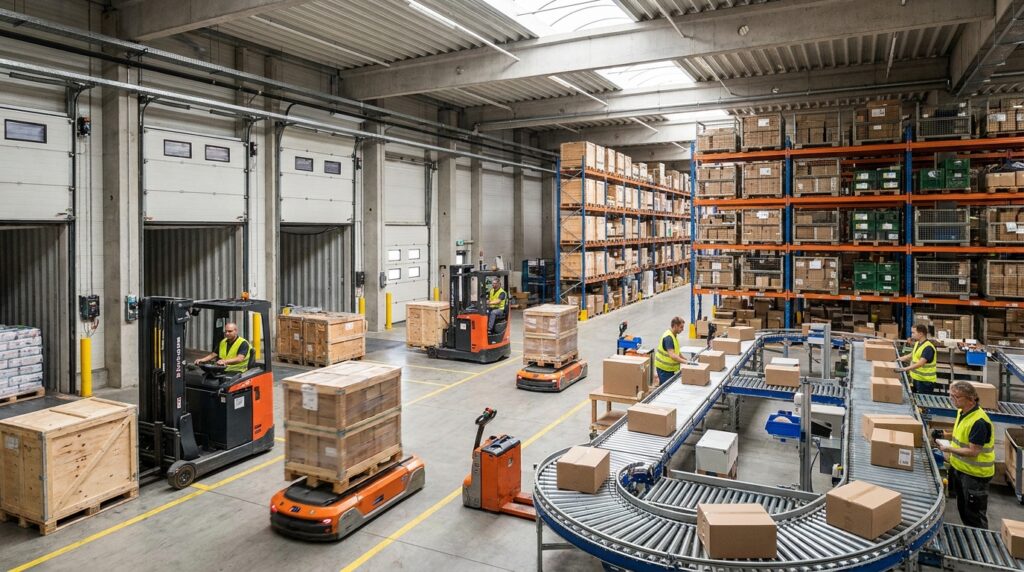
Material handling is a broad discipline that touches virtually every industry where goods are produced, stored, distributed or consumed. Whether you operate a small fabrication shop or a multi-million-square-foot distribution center, the way you move, protect, store and control materials has a direct impact on productivity, safety, cost control and customer satisfaction. Understanding the fundamentals of material handling—and the equipment, methods and best practices that support it—gives operations professionals a powerful lever for continuous improvement.
Defining Material Handling and Why It Matters
Material handling refers to the movement, protection, storage and control of materials and products throughout the processes of manufacturing, warehousing, distribution, consumption and disposal. The definition is intentionally broad because material handling encompasses everything from a worker pushing a hand truck across a shop floor to an automated conveyor system sorting thousands of parcels per hour.
The Material Handling Institute (MHI) identifies material handling as one of the most significant contributors to operating cost in manufacturing and distribution environments. Studies consistently show that material handling can account for 25–70 percent of total operating costs depending on the industry. Despite this, many facilities treat material handling as an afterthought rather than a strategic function.
When material handling is planned and executed well, the results are tangible:
- Lower labor costs – Workers spend less time walking, searching and manually lifting.
- Improved safety – Ergonomic equipment and engineered workflows reduce injuries.
- Higher throughput – Products move faster from receiving to shipping.
- Better space utilization – Intelligent storage systems maximize cubic capacity.
- Greater accuracy – Controlled material flow reduces picking and shipping errors.
- Reduced product damage – Proper handling and storage protect inventory integrity.
For industrial buyers, facility managers and warehouse managers, a firm grasp of material handling principles is essential for making informed equipment investments and designing efficient operations.
Material handling is a crucial aspect of logistics and supply chain management, encompassing the movement, protection, and control of materials throughout the manufacturing and distribution processes. For those looking to explore a variety of solutions and products related to material handling, you can find valuable information in this article: Explore Material Handling Products. This resource provides insights into various equipment and systems designed to enhance efficiency and safety in material handling operations.
Core Principles of Effective Material Handling
The Material Handling Institute has published a set of widely accepted principles that guide professionals when designing or improving material handling systems. While the full list contains ten principles, several deserve special attention because they influence nearly every equipment and layout decision.
Planning Principle
All material handling activities should be the result of a deliberate plan. Before purchasing equipment or redesigning a layout, map existing material flows, identify bottlenecks, quantify volumes and define objectives. A planning exercise often reveals that a simple change in process sequence or storage location eliminates unnecessary moves entirely.
Unit Load Principle
Handling materials in larger, standardized unit loads—pallets, totes, containers—reduces the number of individual moves required. Pallet racking systems, for example, allow you to store and retrieve full unit loads efficiently, minimizing handling cycles and reducing the risk of damage that comes with loose handling.
Space Utilization Principle
Effective material handling maximizes the use of cubic space, not just floor space. Vertical storage solutions such as mezzanines, vertical lift modules and high-density pallet racking allow facilities to store more product within the same building footprint. This is especially valuable in regions where real estate costs are high or facility expansion is impractical.
Ergonomic Principle
Equipment and procedures should be designed to minimize physical effort and reduce the risk of injury. Hydraulic lifts, adjustable-height workstations, vacuum lifters and tilt tables bring work to the operator at a comfortable height and position, directly reducing musculoskeletal injuries and workers’ compensation costs.
Automation Principle
Automation should be applied where it improves consistency, speed and safety—but only after manual processes have been optimized. Automating a broken process simply creates an automated broken process. Once workflows are sound, technologies like conveyors, automated guided vehicles (AGVs), robotic palletizers and warehouse management systems deliver measurable returns.
Major Categories of Material Handling Equipment
Material handling equipment falls into four broad categories. Understanding these categories helps operations professionals identify the right solutions for specific challenges.
Transport Equipment
Transport equipment moves materials from one location to another within a facility or between facilities. Common examples include:
- Forklifts and powered industrial trucks – The workhorses of warehousing and manufacturing, available in counterbalance, reach, narrow-aisle and rough-terrain configurations.
- Conveyors – Belt, roller, chain and overhead conveyor systems provide continuous or intermittent movement of products along a fixed path.
- Cranes and hoists – Overhead bridge cranes, jib cranes and chain hoists handle heavy or awkward loads that cannot be managed with standard lift trucks. These are indispensable in fabrication shops, steel service centers and heavy manufacturing.
- AGVs and autonomous mobile robots (AMRs) – Self-guided vehicles that transport materials without operator intervention, ideal for repetitive point-to-point moves.
Positioning Equipment
Positioning equipment is used to manipulate materials at a single location—lifting, tilting, rotating or feeding items so they can be worked on, assembled, packed or loaded. Examples include:
- Hydraulic lift tables and scissor lifts – Raise or lower materials to ergonomic working heights, reducing bending and stooping.
- Tilters and upenders – Rotate loads for easier access or processing.
- Balancers and manipulators – Assist workers in handling heavy parts during assembly.
- Adjustable workstations – Ergonomic work surfaces that accommodate varying tasks and operator heights.
Storage Equipment
Storage equipment is designed to hold materials in an organized, accessible manner when they are not actively being transported or processed. Key types include:
- Selective pallet racking – The most common racking configuration, providing direct access to every pallet position. Ideal for facilities with a high number of SKUs.
- Drive-in and drive-through racking – High-density storage for large quantities of the same SKU. Forklifts enter the rack structure to place or retrieve pallets.
- Push-back and pallet flow racking – Dynamic systems that use gravity to move pallets, increasing storage density while maintaining selectivity.
- Cantilever racking – Designed for long, bulky items like lumber, pipe, bar stock and sheet goods.
- Shelving and bin storage – For small parts, components and loose items that don’t lend themselves to pallet storage.
- Mezzanines – Freestanding elevated platforms that create additional floor space above existing operations without expanding the building footprint.
Identification and Control Equipment
This category includes the technologies used to track and manage materials as they flow through a facility:
- Barcode and RFID systems – Enable real-time inventory tracking and order accuracy.
- Warehouse management systems (WMS) – Software that orchestrates receiving, putaway, picking, packing and shipping.
- Sensors and IoT devices – Monitor equipment utilization, environmental conditions and material flow metrics.
Common Material Handling Methods Across Industries
Different industries and operational models call for different material handling methods. Here is a practical look at how material handling is applied in several common environments.
Manufacturing Facilities
In manufacturing, material handling focuses on moving raw materials to production lines, transferring work-in-process between stations and routing finished goods to storage or shipping. Overhead cranes and hoists handle heavy components. Conveyors link production cells. Hydraulic lifts and ergonomic workstations position parts for assembly. Pallet racking and mezzanines store raw materials, tooling and finished inventory.
A well-designed manufacturing material handling system minimizes non-value-added movement and supports just-in-time (JIT) production by delivering the right material to the right workstation at the right time.
Warehousing and Distribution
Warehouses are, by definition, material handling operations. Products arrive at receiving docks, get put away into storage locations, are picked to fill orders and are packed and shipped from loading dock equipment such as dock levelers, dock shelters and vehicle restraints.
Efficiency in warehousing hinges on storage density, pick-path optimization and dock throughput. Selective and high-density pallet racking systems form the backbone of warehouse storage. Conveyors and sortation systems accelerate order fulfillment. Proper loading dock equipment ensures safe, efficient trailer loading and unloading.
Construction and Heavy Industry
Material handling in construction and heavy industry involves moving oversized, heavy and irregularly shaped loads. Cranes—tower cranes, mobile cranes and overhead bridge cranes—are essential. Hoists and rigging equipment lift structural steel, precast concrete and heavy machinery. Specialized transport equipment like heavy-duty carts and rail-guided vehicles handle loads that exceed the capacity of standard forklifts.
Retail and E-Commerce Fulfillment
The explosive growth of e-commerce has reshaped material handling in fulfillment centers. Each-pick operations—where individual items are picked rather than full cases or pallets—demand different equipment and processes. Mezzanine-level pick modules, goods-to-person robotic systems, pack stations with ergonomic workstations and high-speed sortation systems are hallmarks of modern e-commerce fulfillment.
Material handling is a crucial aspect of logistics and supply chain management, focusing on the movement, protection, and storage of materials throughout the manufacturing and distribution processes. For a deeper understanding of the various techniques and equipment used in this field, you can explore a related article that delves into the intricacies of material handling systems. This resource provides valuable insights into optimizing operations and improving efficiency. To learn more, visit this article for comprehensive information on the subject.
Safety Considerations in Material Handling Operations
Material handling is one of the leading sources of workplace injuries. The U.S. Bureau of Labor Statistics reports that overexertion, contact with objects and falls related to material handling tasks account for a significant share of days-away-from-work injuries each year. A responsible material handling strategy places safety on equal footing with productivity.
Ergonomic Risk Reduction
Manual lifting, repetitive reaching and awkward postures are primary injury drivers. Equipment such as hydraulic lift tables, adjustable workstations, vacuum lifters and tilt tables reduce physical demands on workers. OSHA’s recommended weight limit for manual lifting—51 pounds under ideal conditions—serves as a useful benchmark, but even lighter loads can cause injury with repetitive handling.
Equipment Safety and Training
Every piece of powered material handling equipment—forklifts, cranes, hoists, conveyors—requires proper training for operators. OSHA mandates forklift operator training and certification under 29 CFR 1910.178. Crane and hoist operators must be qualified under applicable OSHA and ASME standards. Conveyors require guarding, emergency stops and lockout/tagout procedures.
Facility Design and Housekeeping
Clear aisle markings, adequate lighting, floor condition maintenance and separation of pedestrian and vehicle traffic are fundamental to safe material handling. Rack inspections should be conducted regularly to identify damage from forklift impacts, and damaged components should be repaired or replaced promptly. Column guards, end-of-aisle protectors and rack-mounted safety netting reduce the risk of rack collapse and falling inventory.
Load Integrity
Improperly stacked, wrapped or secured loads create hazards during storage and transport. Stretch wrapping, strapping, slip sheets and proper palletization techniques keep unit loads stable throughout the supply chain.
Selecting the Right Material Handling Equipment: Practical Guidance
Choosing material handling equipment is a significant capital decision. The following framework helps operations professionals evaluate options systematically.
Assess Your Material Flow
Before evaluating equipment, document your material flow in detail. Map every movement from receiving through shipping. Identify distances, volumes, weights, frequencies and any constraints imposed by building dimensions, floor load capacities or regulatory requirements. This baseline data is essential for right-sizing equipment.
Match Equipment to the Application
Avoid the temptation to over-specify or under-specify. A facility handling 200 pallets per day has different needs than one handling 2,000. Consider:
- Load characteristics – Weight, size, shape, fragility and temperature sensitivity dictate equipment type and capacity.
- Throughput requirements – High-volume operations may justify conveyors or automated systems, while lower volumes may be served efficiently by forklifts and manual handling aids.
- Storage profile – SKU count, inventory turns and order profiles determine the optimal racking configuration—selective, high-density, flow or a combination.
- Ceiling height and floor space – Vertical solutions like mezzanines and high-reach racking maximize cubic utilization.
- Growth projections – Design for reasonable growth. Modular equipment such as bolted pallet racking and freestanding mezzanines can be expanded or reconfigured as needs evolve.
Evaluate Total Cost of Ownership
Purchase price is only one component of equipment cost. Factor in installation, training, maintenance, energy consumption, spare parts availability and expected useful life. A more expensive piece of equipment with lower ongoing costs and greater durability may deliver a better return over its lifecycle.
Engage Experienced Partners
Material handling system design benefits enormously from experience. An equipment provider that understands the interplay between racking, lifts, dock equipment, cranes, conveyors and workstations can help you avoid costly mistakes and identify solutions you may not have considered. A holistic approach—rather than purchasing each piece of equipment in isolation—produces a more efficient, safer and more cost-effective operation.
Building a Smarter Material Handling Strategy
Material handling is far more than forklifts and shelving. It is a discipline that, when approached strategically, delivers compounding benefits across safety, productivity, cost reduction and customer service. Whether you are planning a new facility, expanding an existing one or simply looking to improve a specific bottleneck, the principles and methods outlined here provide a solid foundation for informed decision-making.
The right combination of pallet racking, hydraulic lifts, ergonomic workstations, loading dock equipment, cranes, hoists, mezzanines and other material handling equipment—selected and integrated with care—transforms material flow from a cost center into a competitive advantage.
Ready to improve your material handling operations? Talk to a Fredon Handling expert today. Our team can help you assess your current material flow, identify opportunities for improvement and select the right equipment solutions for your facility, budget and growth plans. Contact Fredon Handling to get started.