
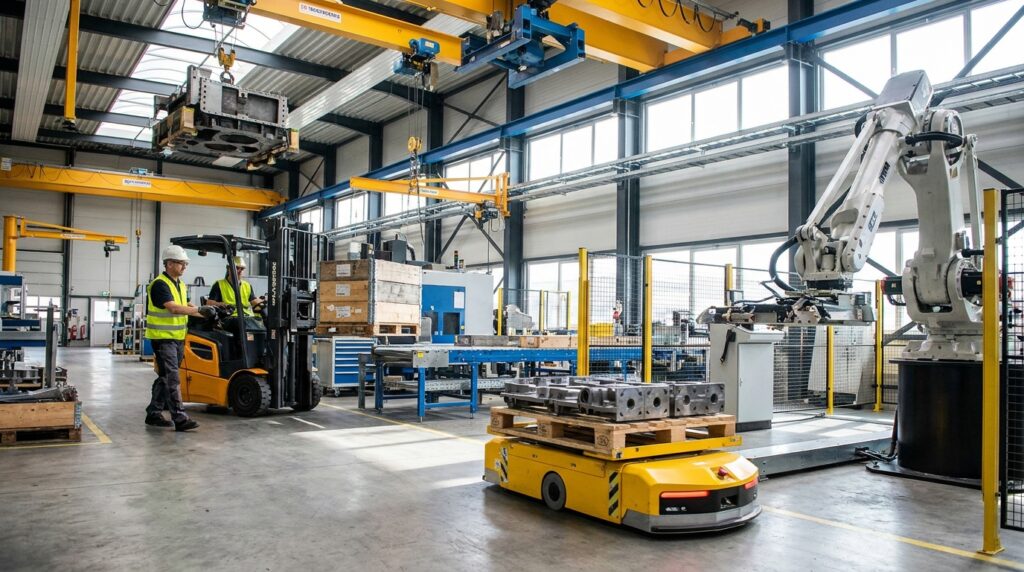
Manufacturing facilities rely on a carefully orchestrated flow of raw materials, work-in-progress components and finished goods to maintain productivity and profitability. When that flow breaks down—whether because of bottlenecks at a loading dock, inefficient lifting at a workstation or poorly organized storage—throughput suffers, costs climb and workplace injuries become more likely. Selecting the right material handling equipment for manufacturing processes is one of the most impactful decisions an operations team can make.
This guide walks through the core categories of equipment that keep manufacturing environments running smoothly, explains how to match solutions to specific operational needs and highlights the safety and efficiency considerations that separate a well-designed material handling system from one that holds a facility back.
Why Material Handling Equipment Is the Backbone of Manufacturing Efficiency
Material handling accounts for a significant share of total manufacturing cost—some industry estimates place it between 20 and 50 percent of overall operating expenses. Every time a part is moved, lifted, staged, stored or transported, labor hours, energy and floor space are consumed. The right equipment minimizes those touches, reduces cycle times and protects both workers and products.
Beyond cost, there is a direct link between material handling and three operational priorities that every facility manager cares about:
- Throughput and on-time delivery. Equipment that moves materials faster and more reliably keeps production lines fed and shipping schedules intact.
- Worker safety and ergonomics. Lifting, bending and repetitive motion are leading causes of musculoskeletal injuries in manufacturing. Mechanical assists, hydraulic lifts and ergonomic workstations reduce physical strain and lower incident rates.
- Space utilization. Vertical storage systems, mezzanines and compact staging solutions allow facilities to do more within their existing footprint, delaying or eliminating the need for costly expansions.
Understanding these drivers helps decision-makers justify capital investments and prioritize upgrades that deliver the highest return.
For those interested in learning more about the various types of Material Handling Equipment used in manufacturing, a related article can be found at this link: Fredon Handling Education Center. This resource provides valuable insights into the latest trends, technologies, and best practices in material handling, helping manufacturers optimize their operations and improve efficiency.
Conveyors, Carts and Transport Systems That Keep Materials Moving
Moving materials between process steps—receiving to storage, storage to production, production to shipping—is the most visible material handling function. The equipment used for in-plant transport varies widely depending on load size, weight, distance and frequency.
Belt, Roller and Chain Conveyors
Conveyors are the workhorses of continuous and high-volume manufacturing. Belt conveyors handle irregularly shaped items and lighter loads; gravity and powered roller conveyors work well for cartons, totes and palletized goods; and chain conveyors manage heavy or hot items common in metalworking and automotive plants. Key selection factors include:
- Load weight and dimensions
- Required throughput speed
- Incline or decline requirements
- Integration with automated sorting or diverting systems
Conveyors are most cost-effective when the same materials travel the same path repeatedly. For operations with variable routings, mobile solutions may be a better fit.
Industrial Carts, Tuggers and AGVs
Platform carts, shelf carts and specialized die or mold carts provide flexible point-to-point transport for lower-volume or variable-path moves. Tugger train systems pull multiple carts along a fixed route, mimicking a conveyor’s efficiency without permanent infrastructure. Automated guided vehicles (AGVs) and autonomous mobile robots (AMRs) add another layer of automation, navigating facilities with sensors and software to deliver materials without operator intervention.
For many mid-size manufacturers, a combination of carts for ad-hoc moves, tugger routes for repetitive line-side delivery and conveyors for high-volume trunk lines provides the best balance of flexibility and efficiency.
Lifting and Positioning Equipment for Safe, Precise Material Handling
Wherever materials need to be raised, lowered, tilted or positioned—at a workstation, on a production line or at a loading dock—lifting equipment plays a critical role. Choosing the right lift reduces injury risk, improves cycle time and protects product quality.
Hydraulic Lift Tables and Scissor Lifts
Hydraulic lift tables are among the most versatile pieces of material handling equipment in a manufacturing facility. They raise heavy loads to ergonomic working heights, serve as adjustable-height assembly platforms and transfer materials between conveyors at different elevations. Scissor-style lifts are available in stationary, portable and pit-mounted configurations, with capacities ranging from a few hundred pounds to tens of thousands.
Common manufacturing applications include:
- Raising pallets to operator waist height for depalletizing or order picking
- Positioning dies or tooling in press shops
- Bridging height differences between conveyor sections or dock levels
- Feeding parts to robotic cells or automated assembly equipment
Fredon Handling offers a range of hydraulic lifts and ergonomic positioning equipment designed for these exact scenarios, helping manufacturers reduce manual lifting and keep production moving.
Overhead Cranes, Hoists and Jib Cranes
When loads are too heavy, too large or too awkward for a lift table or forklift, overhead cranes and hoists provide the answer. Bridge cranes span an entire bay and travel the length of a building, making them ideal for heavy fabrication, steel service centers and large-assembly operations. Gantry cranes offer similar capability in a freestanding structure that does not require building-column support. Jib cranes mount on columns or walls and serve individual workstations with a rotating boom arm, perfect for repetitive pick-and-place tasks.
Hoists—whether electric chain, wire rope or pneumatic—are the lifting mechanisms that pair with these crane systems. Selection depends on:
- Capacity – rated load including rigging and below-the-hook devices
- Lift height – distance from lowest hook point to highest hook point
- Duty cycle – frequency and duration of lifts per shift
- Environment – explosive atmospheres, corrosive chemicals, extreme temperatures or cleanroom requirements
Fredon’s crane and hoist solutions span light-duty jib cranes for individual workstations to heavy-capacity bridge cranes for demanding production environments, all specified to meet applicable OSHA and ASME standards.
Ergonomic Manipulators and Vacuum Lifters
For lighter but repetitive lifts, ergonomic manipulators and vacuum lifting devices dramatically reduce operator fatigue. Vacuum lifters handle sheet goods, panels, glass and bags with suction cups, while articulating-arm manipulators orient parts with zero-gravity feel. These tools are especially valuable on assembly lines where workers handle dozens of parts per hour.
Storage and Staging Solutions That Maximize Floor Space
Efficient manufacturing depends not only on moving materials but also on storing them in a way that supports fast retrieval, accurate inventory and minimal wasted space.
Pallet Racking Systems
Pallet racking is the foundation of organized bulk storage. Several configurations serve different operational profiles:
- Selective racking provides direct access to every pallet position and is the most common choice for facilities with diverse SKUs.
- Drive-in and drive-through racking offers dense storage for high-volume, low-SKU environments by allowing forklifts to enter the rack structure.
- Push-back and pallet-flow racking use gravity to move pallets toward the pick face, supporting LIFO or FIFO inventory strategies respectively.
- Cantilever racking handles long, awkward items such as bar stock, pipe, lumber and sheet goods.
Fredon Handling supplies and installs pallet racking systems tailored to each customer’s load profiles, building dimensions and throughput requirements, ensuring code-compliant designs that maximize every cubic foot of available space.
Mezzanines and Elevated Work Platforms
When floor space is at a premium, building upward with a structural steel mezzanine effectively doubles usable area without expanding the building envelope. Mezzanines serve as additional storage levels, elevated assembly areas, office space above production floors or pick module platforms in distribution-oriented manufacturing operations.
Design considerations include:
- Live load capacity (typically 125 to 300+ pounds per square foot for industrial applications)
- Column placement relative to existing equipment and traffic lanes
- Access via stairways, conveyors or vertical lifts
- Fire code and building permit requirements
Fredon’s mezzanine solutions are engineered to integrate with existing operations, providing additional productive space with minimal disruption during installation.
Workstations and Lean Manufacturing Stations
Organized, well-equipped workstations are a form of material handling equipment often overlooked. Ergonomic workbenches with integrated tool storage, parts bins, lighting and adjustable-height surfaces keep materials within arm’s reach and eliminate unnecessary walking, reaching and searching. In lean manufacturing environments, purpose-built workstations support standardized work, visual management and one-piece flow.
Fredon offers industrial workstations that can be configured with shelving, drawer units, power strips, ESD protection and integrated lifting devices to match the specific demands of each process step.
In the realm of manufacturing, the efficiency of operations often hinges on the effectiveness of Material Handling Equipment. For those looking to enhance their understanding of this critical aspect, a related article can provide valuable insights. You can explore more about optimizing your manufacturing processes by visiting this resource, which discusses various strategies and equipment options that can streamline operations and improve productivity.
Loading Dock Equipment and Receiving Solutions
The loading dock is where inbound materials enter the facility and finished goods leave it. Inefficiencies here ripple through the entire operation. Proper dock equipment ensures safe, fast trailer loading and unloading regardless of trailer height, weather conditions or load type.
Dock Levelers, Bumpers and Seals
Dock levelers bridge the gap and height difference between the warehouse floor and trailer bed. Mechanical, hydraulic and air-powered models accommodate different traffic volumes and budgets. Dock bumpers protect the building structure from trailer impact, and dock seals or shelters create a weather-tight connection to maintain interior climate control and protect materials from moisture and contamination.
Vehicle Restraints and Safety Barriers
Trailer creep and premature departure are among the most dangerous dock hazards. Vehicle restraint systems physically lock the trailer to the dock until loading or unloading is complete. Combined with dock lights, traffic signals and safety barriers, these systems create a loading dock environment that meets OSHA requirements and protects workers and equipment.
Fredon Handling provides comprehensive loading dock equipment packages—including levelers, restraints, seals and accessories—designed as integrated systems rather than afterthought add-ons.
In the realm of manufacturing, the efficiency of operations heavily relies on the effective use of Material Handling Equipment. For those looking to deepen their understanding of this essential topic, an insightful article can be found at this link, which explores various types of equipment and their applications in streamlining production processes. By integrating the right tools, manufacturers can enhance productivity and ensure a safer work environment.
How to Select the Right Material Handling Equipment for Your Facility
With so many equipment categories and options, a structured selection process prevents costly mistakes.
Assess Current Material Flow and Pain Points
Start by mapping how materials move through the facility today. Identify bottlenecks, excessive manual handling, safety hazards and areas where materials wait in queue. Time studies, spaghetti diagrams and worker input are invaluable at this stage.
Define Requirements Before Shopping for Equipment
For each identified need, document:
- Load characteristics (weight, dimensions, fragility, temperature)
- Volume and frequency of moves
- Available space and ceiling height
- Power availability (electric, pneumatic, hydraulic)
- Environmental factors (dust, moisture, hazardous atmospheres)
- Integration with existing equipment or automation
Prioritize Safety and Compliance
Every piece of material handling equipment must meet applicable OSHA regulations, ANSI standards and local building codes. Rated capacities should never be exceeded, operators must be trained and equipment must be inspected and maintained on a documented schedule. Cutting corners on safety generates far greater costs than the equipment itself.
Consider Total Cost of Ownership
Purchase price is only part of the equation. Factor in installation, operator training, energy consumption, maintenance requirements, spare parts availability and expected service life. A higher-quality hydraulic lift or pallet racking system that lasts 20 years with minimal maintenance frequently delivers a lower total cost than a budget alternative that requires frequent repairs or early replacement.
Partner with an Experienced Material Handling Supplier
The most effective approach is to work with a supplier that understands the full range of material handling solutions—from pallet racking and mezzanines to cranes, lifts and dock equipment—and can design an integrated system rather than selling individual products in isolation. An experienced partner brings application knowledge, engineering capability and installation expertise that shortcut the selection process and reduce project risk.
Building a Material Handling Strategy That Grows with Your Operation
The best material handling systems are designed with future growth in mind. Modular racking that can be reconfigured, mezzanines that accept additional bays, and crane runways sized for heavier future loads all provide flexibility that protects today’s investment. As manufacturing processes evolve—incorporating more automation, shifting product mixes or scaling volume—the underlying material handling infrastructure should adapt without requiring wholesale replacement.
Regular audits of material flow, equipment condition and safety performance ensure the system continues to perform as operations change. Tracking metrics such as throughput per labor hour, injury frequency rates and dock-to-stock cycle times makes the value of material handling investments visible and supports data-driven decisions about future upgrades.
Ready to improve efficiency and safety in your manufacturing operation? Fredon Handling’s team of material handling experts can assess your facility, recommend the right equipment and design an integrated solution tailored to your specific processes and growth plans. Talk to a Fredon material handling expert today to get started.